



The NASA/ESA Hubble Space Telescope and the NASA/ESA/CSA James Webb Space Telescope have turned their cameras on an eerie pillar of gas and dust with a glowing red ‘eye,’ probably a young star still wrapped in its cocoon.
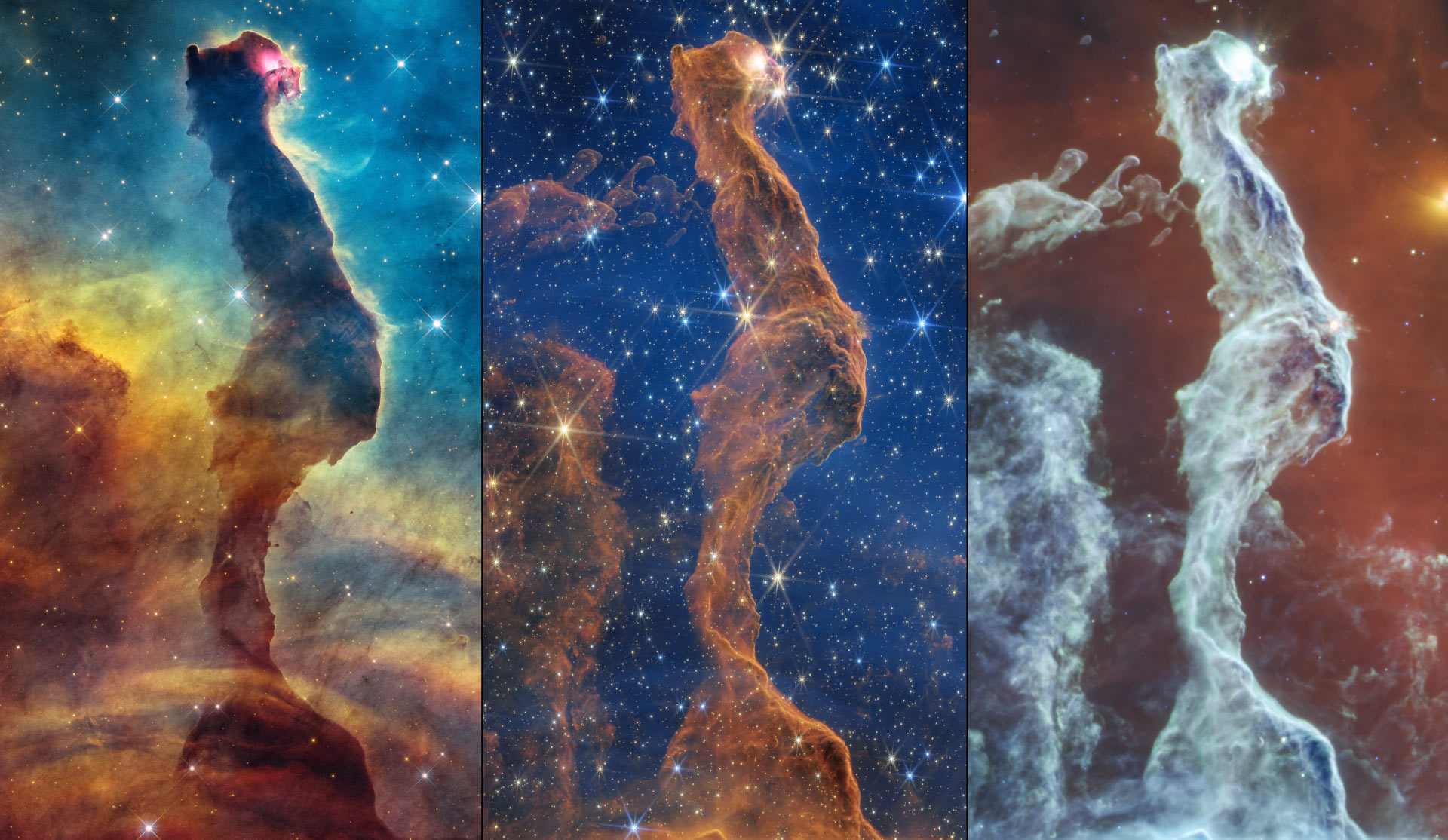
A collage of three images of the Cat’s Head Nebula: on the right is a Hubble visible-light image; in the center is Webb’s NIRCam view where bright red spot marks the eye; on the right is Webb’s MIRI view. Image credit: NASA / ESA / CSA / Hubble / Webb.
The small area Hubble and Webb observed is nicknamed the Cat’s Head Nebula because of its resemblance to a cat sitting with its back toward the viewer.
It lies within the Carina Nebula, a diffuse star-forming region located about 7,500 light-years away in the constellation of the same name.
“Though the Cat’s Head Nebula is a temporary scene that will eventually disperse as stars form and evolve over time, the region is packed with information,” members of the Hubble and Webb teams said in a statement.
“The distinctive cat’s head shape of the nebula was likely sculpted over time by the intense ultraviolet radiation and winds from massive stars in the Carina Nebula.”
“As this stellar feedback erodes the surrounding gas and dust, denser material within the feline-shaped pillar resists erosion, at least for now.”
“Hubble’s visible-light view reveals an opaque, dark brown pillar of dust.”
“The cat’s glowing red eye may indicate a young star that is still partially embedded in dust.”
“A ridge of hazy yellow seems to follow the edge of the filament’s right side.”
“This bright rim is consistent with gas illuminated and ionized by ultraviolet radiation from nearby massive stars, potentially driving a process known as photoevaporation.”
“The diffuse material surrounding the pillar glows blue and cyan above, shifting to yellow, orange, and red toward the bottom.”
“Webb’s near- and mid-infrared images each offer different pieces of information to help create a more well-rounded understanding of the Cat’s Head Nebula,” they added.
“While the nebula’s overall structure is similar to the visible-light image, the filament becomes more transparent, and its complex surface structure becomes discernable in near-infrared light.”
“On the cat’s left are ghostly wisps of dust and gas, delicate structures exposed to radiation from nearby massive stars.”
hubble-and-webb-telescopes-zoom-in-on-cats-head-nebula