



The split between working and show lines of German Shepherds has left a measurable mark on the breed’s genes and temperament, according to a research team led by Uppsala University scientists.

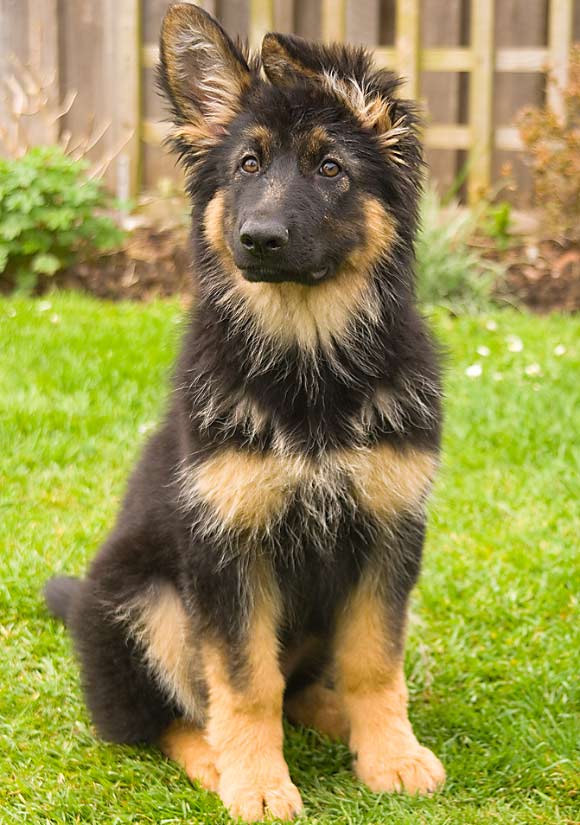
German shepherd puppy. Image credit: Marilyn Peddle / CC BY 2.0.
“Breeders of working dogs have selected and bred the ones that really enjoy working; it’s a bit like a game for them,” said Uppsala University’s Professor Kerstin Lindblad-Toh, senior author of the study.
“It’s interesting that we can now see that this selective breeding has indeed led to differences between working dogs and show dogs among German Shepherds — differences that can be seen at both the behavioral and genetic levels.”
For their new research, the authors analyzed 373 German Shepherds that had been tested with the Dog Mentality Assessment, a standardized behavioral exam widely used in Sweden.
The dogs’ DNA sorted into two distinct clusters that matched their records: one working-type group of 222 dogs, with police and military dogs and working champions, and one show-type group of 132, including all Swedish show champions. Nineteen dogs fell in between.
Working dogs scored higher on nearly every measure except aggressiveness.
The researchers found them to be more playful, curious, quick to chase after toys, less fearful and more socially interested in strangers.
They call this cluster of traits as ‘boldness,’ a measure of the shyness-boldness spectrum in dogs. The biggest gaps between the groups were in playfulness and boldness.
In an analysis of their genomes, the sharpest genetic difference between the two groups sat in a roughly two-million-letter stretch of chromosome 24 that includes genes tied to coat color.
Show dogs were nearly uniform there, and their coats were far more uniform than the working dogs’ coats, which came in a wider range of colors.
For the boldness-related traits, the strongest signals appeared on chromosome 1, near a gene called TCF4.
In people, variants of this gene have been linked to neuroticism, which the scientists treat as roughly the human counterpart of low boldness in dogs.
They argue this suggests dogs could be a useful model for studying human personality.
“We could see that, on average, the working dogs showed less fear, more curiosity and were able to socialize well with humans,” said co-author Professor Åke Hedhammar, a researcher at the Swedish University of Agricultural Sciences.
“This shows how important it is to select for behavior when selecting dogs for breeding for important functional roles in our community.”
“It’s interesting that several of the genes that we identified as influencing behavior in German Shepherds are also linked to that behavior in humans,” Professor Lindblad-Toh said.
“So we now have an example of how we might also acquire more knowledge about different behaviors in people with help of dogs in the long term.”
“These findings could be used to select which dogs have the best prospects of becoming good working dogs and which could be used in breeding,” Professor Hedhammar added.
“But we are not there yet. This study is just a first step and shows that there are actually clear differences in behavior between working and show German Shepherds.”
The team’s results were published November 10 in the journal Animal Genetics.
_____
Voichita D. Marinescu et al. 2026. The Genetic Architecture of Behavior in the German Shepherd Dog. Animal Genetics 57 (6): e70221; doi: 10.1002/age.70221
genes-help-explain-why-german-shepherds-differ-in-boldness